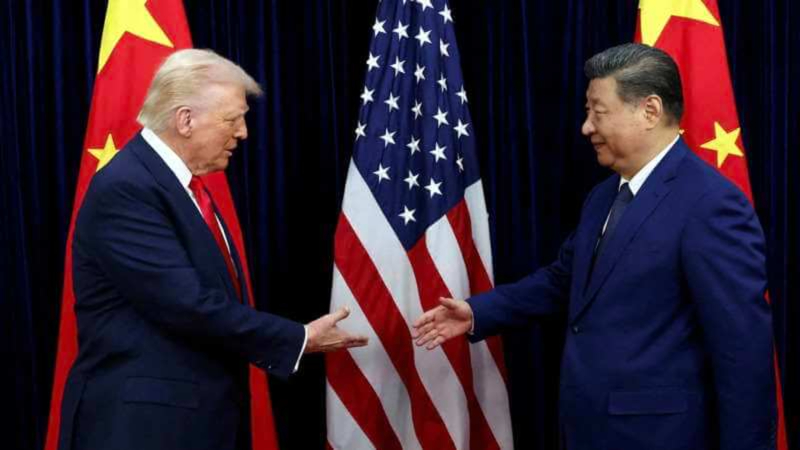
President Trump is set to arrive in Beijing today for a closely watched summit with Chinese President Xi Jinping.
The two-day summit, which kicks off tomorrow, marks the first in-person meeting between Trump and Xi since October, when the leaders of the world’s two largest economies agreed to temporarily cool their trade fight.
Here’s what’s on the agenda for this week:
Trade & economics
US officials are reportedly pushing for increased Chinese purchases of US goods like Boeing airplanes, beef, and soybeans. They’re also seeking to create a formal “Board of Trade” and “Board of Investment” focused on expanding cooperation in less-sensitive industries.
Chinese officials, meanwhile, are expected to focus on agreements that would lower US tariffs and restrictions on advanced semiconductor exports, which are reportedly limiting China’s technology sector.
Iran & global energy
As instability around the Strait of Hormuz continues to disrupt the global oil market, the Trump administration is reportedly seeking to have China agree to help pressure Iran into reopening the strait.
- Beijing has largely framed the conflict as America’s sole responsibility, but also pushed back against recent US sanctions targeting Chinese companies accused of purchasing Iranian oil.
- China is one of the world’s largest buyers of Iranian oil, giving Beijing its own incentive to avoid instability in the region.
Technology & AI
Trump and Xi are expected to discuss AI for the first time this week, amid mounting alarm over potential cyber risks posed by frontier models like Anthropic's Mythos. US officials reportedly aim to explore formal communication channels on AI safety between Washington and Beijing, similar to Cold War-era nuclear hotlines and arms-control talks between rival superpowers.
Analysts say the prospect of AI cooperation is surprising, given that the Trump admin just a few weeks ago accused China-backed actors of “industrial-scale” technology theft from America's leading AI companies.
The Taiwan flashpoint
China describes the self-governed island as the “biggest point of risk” in its relations with the US. Beijing considers Taiwan part of its territory, while the US continues to support Taiwan and its independence both militarily and diplomatically.
Taiwan also produces the vast majority of the world’s most advanced semiconductors, making the island especially important as the US works to limit China’s access to advanced chip technology.
Looking ahead…Analysts say expectations for a major breakthrough in US-China relations remain relatively low, with the more likely outcome being smaller agreements designed to prevent tensions between both countries from escalating further.
📊 Flash poll: Which of the following do you think best describes China’s relationship with the United States?